Patient Safety:
Is diagnostic medical radiation safe?
Safety and Risks
In order to answer the question of whether medical radiation is safe, safety must be defined. What does safe mean? Does it mean:
- there is no risk?
- the risk is very small?
- the benefit exceeds the risk?
If someone tells you the air is safe, does it mean:
- the air is free of pollutants?
- that breathing the air every day is safe?
- that brief exposure to low levels of pollutants is safe, yet constant exposure may not be safe?
Many activities carry some kind of risk. To call something safe usually means that it carries a low risk, not zero risk. Zero risk is almost impossible.
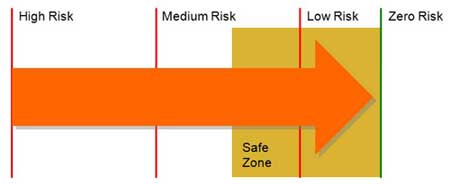
Safety is different for everyone. For example, people with asthma do not tolerate pollution well. What is for people without asthma is not necessarily safe for people with asthma.
An action or product is deemed safe as long as the risk associated with it is very low. This is true for medical x-rays, medication or any medicine. Even so, only patients who need diagnostic imaging should have imaging exams.
Safety and Radiation
Background radiation naturally exists everywhere in the environment. These levels of radiation are clearly safe. If they were not, life on Earth would not flourish. Yet, we know radiation has the potential to cause cancer.
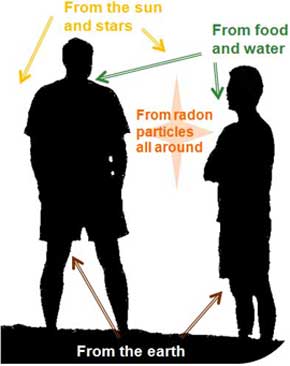
The degree of safety depends on the level of exposure. Ultra-high levels of radiation (levels far above background radiation or in amounts well in excess of those used in diagnostic imaging) may cause cancer to develop later in life.
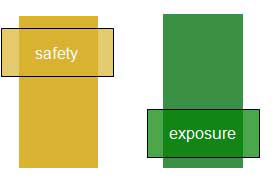
Only a small percentage of people who are heavily exposed to radiation develop radiation-induced cancer later in life. This includes people who are:
- exposed to radiation from nuclear weapons.
- involved in radiation accidents.
- treated for an existing cancer.
The potential for radiation-induced cancer depends on the amount of radiation exposure and accumulation of exposure over a long time. Lower exposure levels—background radiation, nuclear medicine exams, computed tomography (CT) scans, or diagnostic x-rays—carry low risks.
Nevertheless, a large volume of circumstantial evidence suggests that diagnostic levels of radiation probably are associated with a low level of risk for inducing disease many years after exposure. Such an event would be very infrequent. Benefits to patients who are sick or injured are so substantial that the radiation risk becomes a minor factor in their healthcare.
Some imaging examinations are used to screen for disease in healthy people. Annual mammograms find breast cancer early, when it can be treated more successfully. Early diagnosis and treatment far outweigh any radiation risk. By this definition, the examination is safe.
When used in large quantities or when many examinations are performed, the risk from exposure to x-rays increases. In some instances, the accumulated dose from multiple examinations can reach levels where the risk of induced cancer has been identified. This can occur after certain types of CT examinations are repeated five or six times in some adult patients. For some very serious medical conditions, multiple exams are necessary, and the benefits far outweigh the risk.
Safety is a priority. To be safe, medical practitioners should use x-rays only in quantities sufficient for medical care. For example, x-rays for children are scaled down, and multiple examinations are limited to those that are essential. Since babies are small, diagnostic examinations can use far less radiation to obtain necessary pictures.
After 100 years of research, it has been impossible to prove that single, low-dose diagnostic x-rays cause cancer. It is important to use diagnostic exams only when necessary. A necessary exam is safe.


This page was reviewed on August 19, 2011